
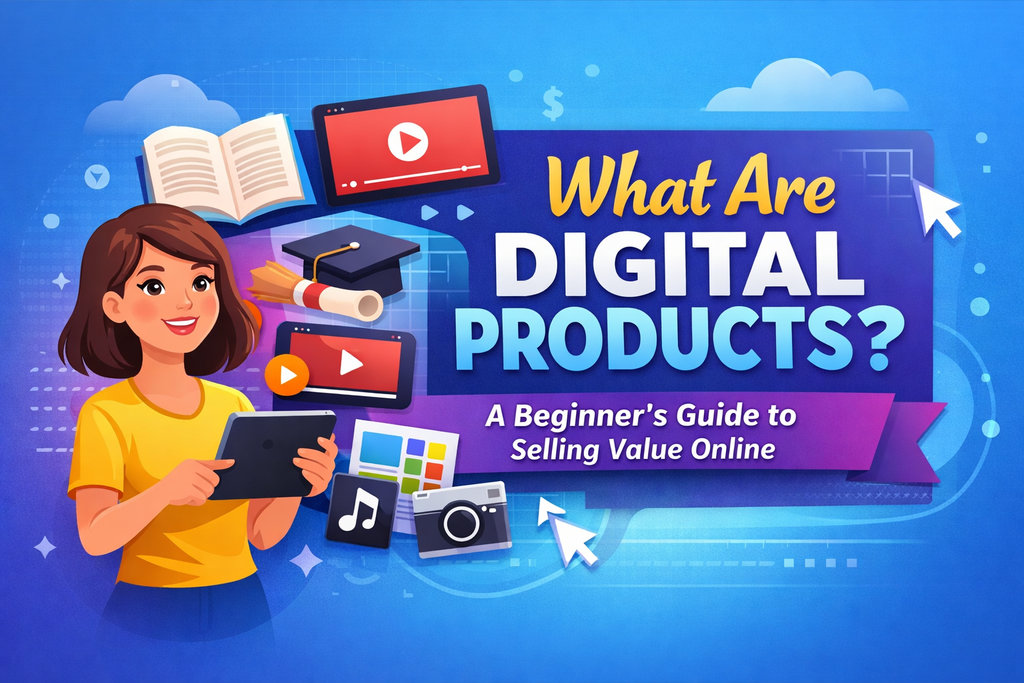
In today’s internet-driven economy, digital products have become one of the most attractive ways to create, share, and sell value online. Unlike physical goods, digital products do not need packaging, warehousing, or shipping. They can be created once and sold repeatedly, making them a powerful option for creators, entrepreneurs, educators, designers, and businesses.
For beginners, the world of digital products may seem broad and confusing at first. You may wonder what qualifies as a digital product, why people buy them, and how selling them online actually works. The good news is that digital products are easier to understand than they appear. At their core, they are simply valuable items delivered in digital form.
This guide will help you understand what digital products are, why they matter, the most common types, their real-world uses, and how beginners can start selling them successfully online.
What Are Digital Products?
Digital products are intangible items that are created, sold, and delivered electronically. They exist in digital form rather than physical form, which means customers can access them through downloads, online platforms, email, apps, or memberships.
A digital product can be as simple as a PDF checklist or as advanced as a full online course, software tool, template bundle, or design asset library. What makes it digital is that it is consumed or used on a device such as a smartphone, tablet, or computer.
Examples of digital products include:
- Ebooks
- Online courses
- Printable planners
- Resume templates
- Website themes
- UI kits
- Stock photos
- Music tracks
- Software tools
- Membership content
- Digital art
- Spreadsheets and calculators
The beauty of digital products is that they transform knowledge, creativity, utility, or convenience into something that can be delivered instantly online.
Why Digital Products Are So Popular
Digital products are growing in popularity because they solve multiple problems for both sellers and buyers.
For sellers, digital products offer scalability. A creator can make one product and sell it to hundreds or even thousands of customers without reproducing it manually each time. This creates strong profit potential compared to physical products, which often involve manufacturing and inventory costs.
For buyers, digital products offer speed and convenience. They can purchase and use a product immediately, often within seconds. There is no waiting for shipping, no concern about stock running out, and no need for physical storage space.
This combination of low delivery friction and high accessibility makes digital products one of the most attractive online business models today.
Main Characteristics of Digital Products
Digital products usually share a few common characteristics.
1. They are intangible
You cannot physically hold a digital product like a book or a T-shirt. Instead, it is stored as a file, platform resource, app feature, or digital access.
2. They can be delivered instantly
Once someone purchases a digital product, they can usually access it right away through download, email, or account login.
3. They are often reusable
Many digital products can be used multiple times. A template, for example, may help a customer complete dozens of tasks over time.
4. They can scale easily
One of the strongest advantages of digital products is that sellers do not need to manufacture a new copy every time a sale happens.
5. They often solve a specific problem
The most successful digital products provide knowledge, save time, improve productivity, support creativity, or simplify complex tasks.
Types of Digital Products
There are many categories of digital products, and each serves different audiences and needs.
Ebooks
Ebooks are one of the most common digital products. They package information, guidance, storytelling, or expertise into a downloadable format, usually PDF or ePub. They are useful for education, self-help, business training, spiritual content, recipes, and many other niches.
Use: Teaching, informing, inspiring, or entertaining readers.
Templates
Templates help people save time by giving them a ready-made structure. These may include resume templates, invoice templates, Canva templates, social media post templates, presentation templates, and website layouts.
Use: Speeding up design, writing, planning, and business tasks.
Printables
Printables are files customers download and print themselves. Examples include planners, to-do lists, wall art, worksheets, party decorations, and kids’ learning materials.
Use: Organization, education, decoration, and events.
Online Courses
Online courses are structured learning products that often include videos, PDFs, quizzes, and assignments. They are highly valuable because they can teach practical skills and complex topics in a step-by-step format.
Use: Education, training, skill development, and certification preparation.
Software and Apps
Software tools, browser extensions, calculators, mobile apps, and plugins are digital products designed to solve technical or business problems.
Use: Automation, productivity, design, analytics, communication, or task management.
Design Assets
These include fonts, icons, illustrations, mockups, stock photos, stock videos, and UI kits. They are bought by designers, marketers, developers, agencies, and creators.
Use: Faster content creation and better visual presentation.
Membership Content
Some digital products are sold through subscription or membership access. Customers pay for ongoing resources such as premium articles, tutorials, downloads, community access, or tools.
Use: Continuous learning, exclusive content, and community value.
Audio and Video Products
This includes music tracks, meditation audios, sound effects, podcast packs, video lessons, and motion graphics assets.
Use: Content creation, relaxation, entertainment, and media production.
Who Can Sell Digital Products?
One of the biggest advantages of digital products is that almost anyone can create and sell them if they have useful knowledge, skills, creativity, or resources.
People who commonly sell digital products include:
- Writers selling ebooks and guides
- Teachers selling courses and worksheets
- Designers selling templates and UI kits
- Developers selling apps, scripts, and plugins
- Coaches selling workbooks and training resources
- Marketers selling social media bundles and business templates
- Photographers selling stock images and presets
- Entrepreneurs building niche digital stores
You do not need to be a large company to start. Even a single creator can build a profitable digital product business.
The Real Value Behind Digital Products
Some beginners think people only pay for physical goods because they seem more “real.” But value does not come from physical form alone. Value comes from usefulness, transformation, and convenience.
A digital product can provide value by:
- Saving time
- Reducing effort
- Improving results
- Teaching a skill
- Solving a problem
- Offering inspiration
- Helping people earn money
- Making work easier
- Organizing life better
For example, a spreadsheet budget planner may cost only a few dollars, but it could help someone manage their finances for years. A resume template could help a job seeker land interviews faster. A course could help someone learn a skill that changes their career.
That is why digital products can be highly valuable even though they are not physical.
Benefits of Selling Digital Products Online
Selling digital products offers several advantages, especially for beginners.
Low startup cost
Unlike physical product businesses, you usually do not need manufacturing, storage, packaging, or shipping. Many digital products can be created with tools you already have.
High scalability
You can create once and sell many times. This makes digital products attractive for long-term income generation.
Global reach
You can sell to customers around the world without opening physical stores or handling international shipping logistics.
Instant delivery
Customers receive their purchase quickly, which improves convenience and satisfaction.
Flexible business model
You can sell one-time downloads, bundles, subscriptions, memberships, or premium upgrades.
Creative freedom
Digital products can be based on your expertise, design ability, technical skill, teaching style, or niche interests.
Common Uses of Digital Products
Digital products are used across many personal and professional settings.
Students use digital products for learning, revision, note-taking, and organization.
Professionals use templates, guides, and software tools to improve productivity.
Businesses use design assets, website templates, and digital systems to save time and launch faster.
Creators use digital resources to produce content more efficiently.
Families use printables for planning, education, and celebrations.
Freelancers use digital toolkits to manage clients, proposals, invoices, and workflows.
This wide range of uses makes digital products relevant in almost every niche.
How Beginners Can Start Selling Digital Products
Starting does not require perfection. It requires understanding a problem and creating a helpful solution.
Step 1: Choose a niche
Pick a topic or audience you understand. This could be education, business, design, fitness, parenting, productivity, finance, spirituality, or technology.
Step 2: Identify a problem
Ask what people in that niche need help with. Are they trying to save time, learn something, get organized, or improve results?
Step 3: Create a simple product
Start with something manageable like a checklist, workbook, planner, template, mini guide, or small course.
Step 4: Package it clearly
Make sure your product looks organized, useful, and easy to understand. Good presentation increases perceived value.
Step 5: Sell through an online platform
You can sell through your own website, a digital marketplace, or an ecommerce platform that supports downloads.
Step 6: Promote it
Use blog posts, social media, SEO, email marketing, YouTube, Pinterest, or paid ads to reach the right buyers.
What Makes a Good Digital Product?
A strong digital product is not just attractive. It is useful and clear.
The best digital products usually have these qualities:
- They solve a clear problem
- They target a specific audience
- They save time or effort
- They are easy to use
- They are well-designed and organized
- They deliver a practical outcome
- They are priced according to value
A beginner mistake is trying to make a product for everyone. In most cases, the more specific the product and audience, the easier it is to sell.
Challenges of Selling Digital Products
Digital products have many advantages, but they also come with challenges.
Competition can be high in popular niches.
Some buyers may expect low prices.
You need strong product presentation and marketing.
Piracy can be a concern for downloadable items.
Refund expectations may vary depending on platform and policies.
Still, these challenges can be reduced by creating high-quality products, serving a clear niche, and building trust with your audience.
Are Digital Products a Good Business for Beginners?
Yes, digital products are often one of the best beginner-friendly online business models. They are especially suitable for people who have useful knowledge, creativity, technical skills, or a desire to package solutions digitally.
They do not require massive capital to begin. They also allow you to start small, test ideas, improve products over time, and build a catalog gradually.
For many beginners, the first sale is not just about money. It is proof that value can be created from knowledge and delivered online. That is a powerful starting point.
Final Thoughts
Digital products are reshaping the way people create, share, and sell value online. They make it possible to turn ideas, knowledge, designs, and tools into scalable online offerings that can help people instantly.
For beginners, digital products are a practical gateway into online business because they are flexible, accessible, and often low-cost to launch. Whether you want to sell an ebook, course, template, printable, software tool, or digital asset bundle, the key is the same: create something useful that solves a real problem.
The digital world rewards value. If your product helps people learn, save time, stay organized, work faster, or achieve better outcomes, it has the potential to succeed.
In the end, selling digital products is not just about making files. It is about packaging value in a form the modern world can access easily.
Comments (0)