In the creator economy, one of the biggest challenges is turning effort into income without staying trapped in a cycle where every new earning depends on more hours of work. Many creators begin by offering services, taking freelance projects, creating sponsored content, or working one-on-one with clients. These approaches can generate income, but they often do not scale easily. Time becomes the limit.
This is where digital products become so powerful.
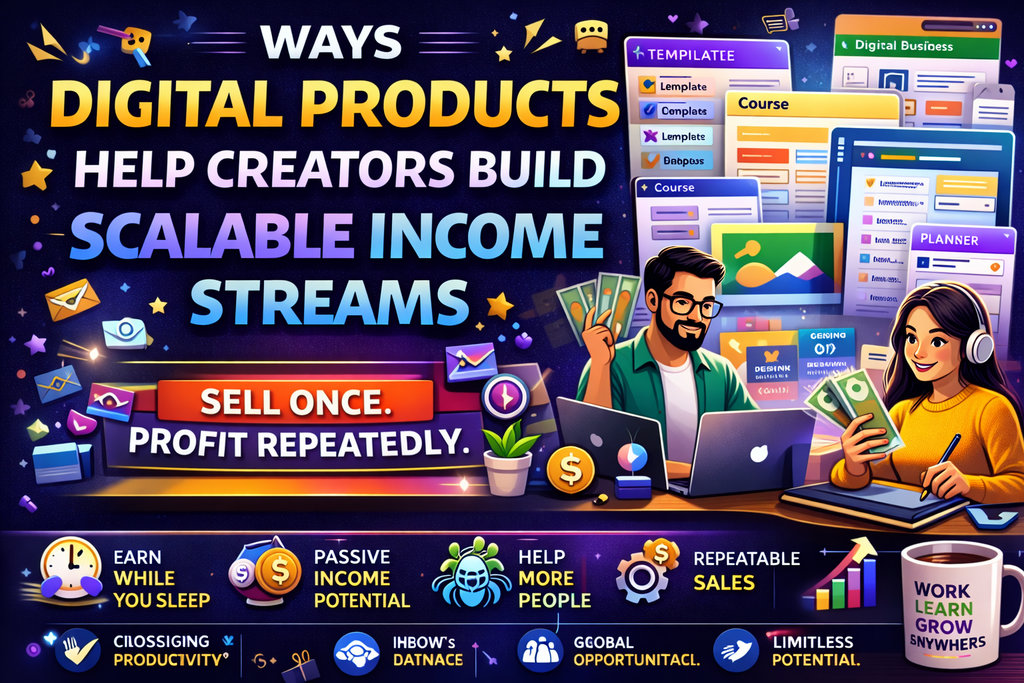
Digital products help creators build scalable income streams by allowing them to package value once and sell or deliver it repeatedly. Instead of earning only when they are actively working with a client or publishing one-off content, creators can build digital assets that continue to generate revenue over time. These assets may come from knowledge, systems, design work, templates, education, organization tools, or creative resources.
For creators, this changes the business model. It turns content and expertise into products. It turns personal effort into repeatable value. And it helps shift income from being fully time-based to becoming more scalable.
This article explores the main ways digital products help creators build scalable income streams, why they matter so much in the modern creator economy, and how they support long-term growth.
What Does Scalable Income Mean for Creators?
Scalable income means earning in a way that does not rise only in direct proportion to hours worked. In a fully time-based model, income usually depends on constant active labor. If the creator stops working, income slows or stops.
A scalable income stream works differently. It allows a creator to earn from something that can be sold, used, or accessed by many people without needing to be recreated from the beginning each time.
For example:
- A freelancer earns once per project
- A digital product creator can earn from the same product many times
- A coach may teach one person at a time
- A course creator can teach many people through one product
This does not mean digital products require no effort. They take real work to build well. But once created, they have more repeatable earning potential.
What Are Digital Products for Creators?
Digital products are non-physical items created, delivered, and used digitally. They can be downloaded, accessed online, or integrated into a digital workflow.
Creators often sell products such as:
- Ebooks
- Online courses
- Templates
- Printables
- Planners
- Worksheets
- Design assets
- Presets
- Stock photos
- Mockups
- Membership content
- Notion templates
- Spreadsheets
- Toolkits
- Resource bundles
These products can be based on creativity, expertise, systems, teaching, or practical utility.
Why Digital Products Matter in the Creator Economy
The creator economy rewards attention, trust, and value. But attention alone does not always create stable income. A creator may have followers, views, or reach, yet still struggle to build dependable revenue if the business depends only on ad payouts, sponsorships, or one-off services.
Digital products matter because they help creators monetize more directly.
They allow creators to turn their audience, skills, and experience into offers that are:
- Repeatable
- Sellable
- Ownable
- Flexible
- Higher margin
- Scalable over time
This is why digital products are often one of the strongest paths from content creation to business building.
1. Digital Products Decouple Income From Hours Worked
One of the most important ways digital products help creators is by reducing the direct link between hours worked and money earned.
In service work, creators often face a hard ceiling. There are only so many hours in a week. Every new client or project demands more time.
A digital product changes that model. A creator may spend time upfront building a course, template pack, planner, or workbook, but after release, that same product can be sold again and again.
This makes income less dependent on constant live delivery and more dependent on product value, positioning, and reach.
That shift is a major step toward scalable income.
2. They Turn Existing Knowledge Into Revenue Assets
Many creators already have valuable knowledge, but they do not always package it. A designer may know branding workflows. A writer may know content structuring. A productivity creator may know planning systems. A teacher may know how to explain difficult topics simply.
Digital products help creators transform that knowledge into revenue-generating assets.
Examples include:
- Turning expertise into an ebook
- Turning methods into a course
- Turning systems into templates
- Turning processes into toolkits
- Turning teaching into worksheets or study guides
Instead of repeating the same advice manually again and again, the creator can package it into a product.
That makes their knowledge reusable and sellable.
3. Digital Products Can Be Sold Repeatedly
A key part of scalability is repeat sales. Digital products help with this because once a product exists, it can be sold to many customers without needing physical reproduction in the traditional sense.
For example:
- One resume template can be sold to hundreds of job seekers
- One social media bundle can be sold to many small businesses
- One online course can serve a growing audience
- One Notion template can be used by thousands of creators or students
This repeatable delivery model is one of the strongest reasons digital products are so attractive for creators who want long-term growth.
4. They Allow Creators to Serve More People at Once
Without digital products, many creators serve people one by one. Coaching, freelancing, consulting, custom design, and personal teaching can all be valuable, but they often limit reach.
Digital products expand reach.
A creator can use them to serve:
- More customers
- More students
- More audience segments
- More global buyers
- More people across time zones
This matters because scale is not only about money. It is also about reach and impact.
A course, workbook, template, or toolkit can help many more people than one-to-one delivery alone.
5. Digital Products Create Layered Income Opportunities
One of the strongest business advantages of digital products is that they allow creators to build multiple revenue layers instead of relying on one source of income.
For example, a creator might offer:
- A low-cost ebook
- A mid-priced template bundle
- A premium course
- A membership library
- A toolkit for business users
This creates a product ladder.
Different buyers can enter at different price points depending on their needs and budget. This makes income more diversified and often more stable than depending only on one offer type.
It also allows creators to increase customer value over time.
6. They Support Passive or Semi-Passive Revenue
Digital products are often connected to passive income, though in reality they are usually better described as semi-passive. They still require creation, updates, customer support, and promotion. But compared to service-based work, they can continue generating revenue with less active delivery effort.
For creators, this matters because it creates space.
A strong digital product can continue earning while the creator:
- Makes new content
- Builds their audience
- Improves other offers
- Takes time off
- Works on future projects
This makes digital products powerful income stabilizers in creator businesses.
7. They Make Audience Monetization More Direct
Many creators build an audience before building a product. But attention without a direct offer can leave income dependent on outside platforms or brand deals.
Digital products help creators monetize directly from the trust they have built.
Instead of relying only on:
- Sponsored posts
- Brand partnerships
- Platform ad revenue
- Affiliate income
They can offer something they own.
This direct monetization is important because it gives creators more control. The audience relationship becomes connected to a product the creator controls fully, rather than only to platform algorithms or advertiser budgets.
8. They Increase Business Ownership and Independence
Scalable income is not only about earning more. It is also about building a business with stronger ownership.
When creators depend heavily on sponsorships or client work, part of their income depends on outside decisions. A brand may stop spending. A client may leave. A platform may change its rules.
Digital products create more independence because the creator owns the product itself.
That means they control:
- Pricing
- Packaging
- Delivery
- Promotion
- Brand positioning
- Product improvements
This ownership gives creators a stronger long-term foundation.
9. They Work Well With Existing Content Ecosystems
Creators often already produce content regularly. Digital products fit naturally into that system.
A blog, YouTube channel, newsletter, Instagram page, or social platform can help a creator promote relevant digital products tied to their niche.
For example:
- A design creator can sell UI kits and branding templates
- A study creator can sell worksheets and planners
- A business creator can sell toolkits and guides
- A writing creator can sell ebook packs or content templates
- A productivity creator can sell Notion dashboards and planning systems
This means creators do not always need to start from zero. Their content can become the marketing engine for their products.
10. Digital Products Help Creators Build a More Predictable Business
Income becomes stressful when it feels random. Digital products can help make a creator business more predictable because they provide repeatable offers that can be improved, promoted, and measured over time.
A creator can begin to track:
- Which products sell best
- Which content drives conversions
- What audience segments buy more
- What pricing works
- Which topics perform strongest
This makes the business more strategic. Instead of earning only from irregular opportunities, the creator has structured offers that can be optimized.
11. They Can Be Bundled for Higher Revenue Per Customer
Another way digital products support scalable income is through bundling.
A creator does not have to sell only one item at a time. They can combine products into packs that increase value and raise average order size.
For example:
- A template creator can sell a bundle of 25 templates
- A teacher can bundle worksheets, guides, and revision sheets
- A business creator can bundle planners, trackers, and launch checklists
- A designer can bundle fonts, icons, and mockups
Bundles increase scalability because they allow the same core work to be sold in more valuable packaging.
12. Digital Products Can Lead to Higher-Tier Offers
Digital products are useful not only because they earn directly, but also because they can lead buyers into premium offers.
For example, a creator might use:
- An ebook to lead into a course
- A template pack to lead into consulting
- A low-cost workshop to lead into coaching
- A toolkit to lead into a membership
- A resource library to lead into enterprise licensing or training
This makes digital products strong business entry points.
They help creators monetize at multiple levels while building trust with buyers who may later invest more deeply.
13. They Scale Better Across Global Markets
Physical products often involve shipping, warehousing, customs, and regional limitations. Digital products avoid much of this complexity.
This helps creators serve a global market more easily.
A creator in one country can sell a template, course, ebook, or toolkit to customers around the world. This expands potential reach significantly and makes digital products especially powerful in internet-based business models.
For creators with niche expertise, global reach can be a major advantage.
14. They Help Creators Build Long-Term Digital Assets
A digital product is more than a sale item. It is a business asset.
Over time, a creator may build a library of assets such as:
- Multiple courses
- Templates for different audiences
- Guides and ebooks
- Resource collections
- Tools and dashboards
- Membership content archives
Each product adds depth to the business. Together, they create a catalog that can keep generating value and revenue.
This is one of the clearest ways creators move from being only content producers to becoming product-based business owners.
15. They Create Better Use of Creative Effort
Creators already spend large amounts of energy generating ideas, solving problems, and producing value. Digital products allow that effort to last longer.
Instead of a useful insight being shared once in a post and disappearing in the feed, it can become:
- A workbook
- A mini course
- A planning system
- A practical guide
- A reusable template
- A premium toolkit
This helps creators get more value from what they already know and make. It turns creative work into lasting business leverage.
Common Types of Digital Products That Help Creators Scale
Different creators scale in different ways depending on their niche and audience.
For educators and coaches
- Courses
- Workbooks
- Guides
- Worksheets
- Memberships
For designers
- UI kits
- Fonts
- Mockups
- Icon packs
- Templates
For business and productivity creators
- Notion templates
- Planners
- Checklists
- Toolkits
- Dashboards
For writers and knowledge creators
- Ebooks
- Resource packs
- Research summaries
- Writing templates
- Content systems
For niche creators
- Industry-specific templates
- Educational packs
- Starter kits
- Mini digital products
- Bundled resources
The best product type usually depends on what problem the creator helps solve.
What Makes a Digital Product Scalable?
Not every digital product scales equally well. The strongest ones usually have several qualities.
Clear usefulness
The product solves a real problem or supports a real goal.
Repeatable demand
It is relevant to more than one buyer and often to many.
Easy delivery
It can be accessed quickly and used without friction.
Strong positioning
The audience understands why it is valuable.
Reusability
The customer can benefit from it more than once or over time.
Quality
The product is organized, polished, and trustworthy.
A scalable product is not only digital. It is genuinely useful and easy to deliver repeatedly.
Challenges Creators Should Keep in Mind
Digital products are powerful, but they are not automatic success. Creators still need to think carefully about:
- Product-market fit
- Audience needs
- Positioning
- Quality
- Promotion
- Pricing
- Customer experience
Common mistakes include:
- Creating products nobody really wants
- Making the product too generic
- Building before understanding the audience
- Overcomplicating delivery
- Relying on the product without marketing it well
Scalable income still requires strategy. The difference is that digital products make that strategy more leverageable.
Why Digital Products Will Keep Growing in Importance for Creators
The creator economy is maturing. More creators now want not only reach, but reliable business models. They want income that is more stable, ownable, and less dependent on platform unpredictability.
Digital products fit this shift well because they provide:
- Ownership
- Scalability
- Direct monetization
- Repeatable value
- Business asset creation
- Better use of expertise
That is why digital products are likely to remain one of the most important ways creators build serious businesses online.
Final Thoughts
Digital products help creators build scalable income streams by turning skills, knowledge, systems, and creative work into repeatable offers that can be sold many times.
They reduce the dependence on hours worked, help creators monetize directly, support product ladders, increase business ownership, and create long-term digital assets that keep generating value over time.
For creators who want to move beyond one-off work and build something more durable, digital products offer one of the clearest paths forward.
In the end, scalable income does not come only from working harder. It often comes from building smarter assets. That is exactly where digital products become so powerful.
Comments (0)