
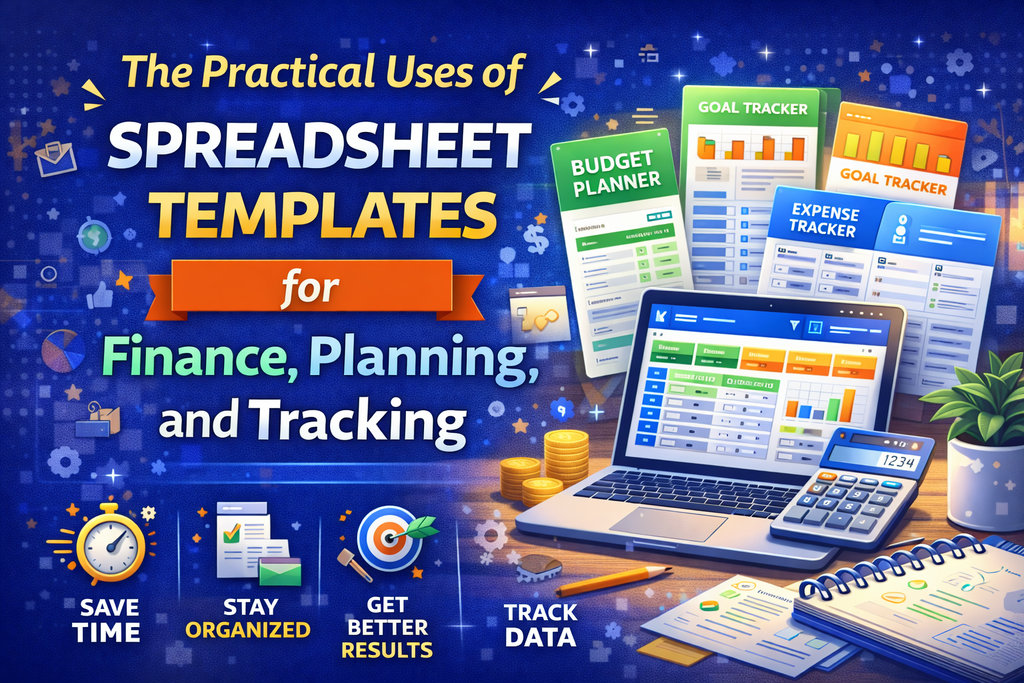
In both personal life and professional work, staying organized often comes down to one simple challenge: keeping information clear, usable, and easy to manage. Whether someone is handling a monthly budget, tracking business expenses, planning a project, monitoring sales, organizing inventory, or reviewing goals, structure matters. Without structure, numbers and tasks can quickly become messy, confusing, and difficult to act on.
This is where spreadsheet templates become incredibly useful.
Spreadsheet templates are among the most practical digital resources available because they turn raw data into organized systems. They help people manage finances, plan activities, monitor progress, and track important details without needing to build every sheet from scratch. A good spreadsheet template saves time, reduces errors, improves clarity, and supports better decision-making.
From individuals trying to control spending to startups tracking growth metrics and teams managing projects, spreadsheet templates remain relevant because they solve real everyday problems in a simple and flexible way.
This article explores the practical uses of spreadsheet templates for finance, planning, and tracking, and why they continue to be some of the most useful digital tools for modern work and life.
What Are Spreadsheet Templates?
Spreadsheet templates are pre-built spreadsheet files designed to help users manage specific kinds of information. They come with ready-made rows, columns, labels, formulas, categories, and layouts so that users can enter their own data into an organized structure.
A spreadsheet template may be used for:
- Budgeting
- Expense tracking
- Sales reporting
- Project planning
- Goal tracking
- Inventory management
- Scheduling
- Content planning
- Debt repayment
- Invoice management
- Habit tracking
- KPI dashboards
Instead of starting with a blank spreadsheet and building the logic manually, users can begin with a structured format already designed for a specific purpose.
That is what makes spreadsheet templates so practical.
Why Spreadsheet Templates Are So Widely Used
Spreadsheet templates remain widely used because they are flexible, familiar, and effective. Many people and businesses deal with recurring information that needs to be organized clearly over time.
Templates help because they offer:
- A ready-made structure
- Easier setup
- Faster data entry
- Built-in organization
- Reusable systems
- Better visibility into numbers and progress
- Support for decisions based on real data
They are especially valuable because they can work for both simple and advanced needs. A person can use one for a home budget, while a business can use another for financial forecasting or campaign tracking.
1. Spreadsheet Templates Simplify Financial Management
One of the most common and practical uses of spreadsheet templates is finance.
Financial information becomes difficult to manage when it is scattered across notes, receipts, memory, or multiple unconnected files. Spreadsheet templates help by creating a structured system for recording and reviewing financial activity.
They are commonly used for:
- Monthly budgets
- Expense tracking
- Income planning
- Savings goals
- Debt repayment tracking
- Cash flow monitoring
- Profit and loss tracking
- Tax preparation support
When money is organized clearly, it becomes easier to understand where it is going, where it is being wasted, and how it can be managed better.
2. They Help People Budget More Effectively
Budgeting is one of the strongest use cases for spreadsheet templates. Many people know they should budget, but struggle to create a simple and consistent system.
A budgeting spreadsheet template solves this by offering prepared sections for:
- Income sources
- Fixed expenses
- Variable expenses
- Savings
- Debt payments
- Remaining balance
- Monthly comparisons
This makes budgeting feel less overwhelming. Instead of figuring out categories, formulas, and structure, the user can focus on entering the numbers and understanding the results.
That simplicity is a major reason budgeting templates remain so useful.
3. Spreadsheet Templates Make Expense Tracking Easier
Expense tracking is important for individuals, freelancers, small businesses, and growing startups. Without a proper tracking system, spending habits and business costs can quickly become unclear.
Expense tracking templates help users record:
- Date of spending
- Expense category
- Amount spent
- Payment method
- Business or personal use
- Notes or purpose
Over time, this creates a useful record that helps identify patterns and improve financial control.
For businesses, this can support cleaner bookkeeping. For individuals, it can reveal spending habits that affect savings or debt reduction goals.
4. They Help With Business Finance and Cash Flow Visibility
For businesses, financial visibility is critical. Knowing revenue alone is not enough. A business also needs to understand expenses, margins, payments due, and cash flow movement.
Spreadsheet templates help businesses manage this more practically by organizing figures into usable reports and trackers.
Common business finance templates include:
- Cash flow sheets
- Sales trackers
- Profit and loss summaries
- Invoice trackers
- Accounts receivable sheets
- Accounts payable trackers
- Budget vs actual comparison sheets
- Revenue dashboards
These templates help business owners stay aware of financial health without needing to build full systems manually.
5. Spreadsheet Templates Support Better Planning
Planning is another area where spreadsheet templates are extremely practical. Planning often involves timelines, tasks, priorities, resources, and progress markers. Without structure, plans remain vague and hard to follow.
Spreadsheet templates help convert ideas into organized action.
They are often used for:
- Project planning
- Business planning
- Event planning
- Marketing calendars
- Product launch planning
- Weekly planning
- Goal planning
- Study planning
A planning sheet helps users move from thinking to structuring. It makes a plan more visible, more realistic, and easier to manage.
6. They Are Useful for Project Planning and Task Management
Project planning often involves multiple steps, deadlines, people, and dependencies. Spreadsheet templates help organize all of this in one place.
A project planning template may include:
- Task names
- Owners
- Start dates
- End dates
- Status indicators
- Priority levels
- Notes
- Milestones
This helps teams and individuals keep track of what is happening and what still needs attention.
Although dedicated project management tools exist, spreadsheet templates remain popular because they are simple, customizable, and easy to share.
7. Spreadsheet Templates Improve Goal Tracking
Many goals fail not because people lack ambition, but because they lack a system for tracking progress. A spreadsheet template can make goals feel more measurable and manageable.
Goal tracking templates are commonly used for:
- Savings goals
- Revenue goals
- Weight or fitness goals
- Reading goals
- Study goals
- Habit consistency
- Business milestones
- Sales targets
They help users define where they are, where they want to go, and how progress is changing over time.
This visual clarity can improve motivation and accountability.
8. They Help With Daily, Weekly, and Monthly Tracking
Tracking is one of the most practical uses of spreadsheet templates. Many important activities become easier to improve when they are tracked consistently.
Templates are often used to monitor:
- Spending
- Sales
- Performance metrics
- Productivity
- Habits
- Inventory levels
- Customer inquiries
- Marketing results
- Employee attendance
- Content publishing
Tracking creates awareness. Awareness leads to better decisions.
A template makes this easier because it removes the effort of designing the tracking system every time.
9. Spreadsheet Templates Are Valuable for Small Businesses and Startups
Small businesses and startups often need organized systems but may not yet have expensive software for every function. Spreadsheet templates are a practical solution because they provide structure at low cost and with high flexibility.
Startups often use spreadsheet templates for:
- Budgeting
- Forecasting
- Sales pipelines
- Customer lists
- Inventory
- Campaign planning
- KPI monitoring
- Hiring trackers
- Expense reports
- Product roadmaps
This makes spreadsheets especially useful in early-stage business environments where speed, simplicity, and cost control matter.
10. They Help Freelancers Stay Organized
Freelancers often manage many parts of their work independently, including clients, invoices, deadlines, projects, and payments. Spreadsheet templates can simplify this by offering ready-made structures for recurring administrative tasks.
Useful freelance spreadsheet templates include:
- Invoice trackers
- Client project trackers
- Payment follow-up sheets
- Monthly income logs
- Expense sheets
- Tax preparation records
- Time tracking logs
- Content delivery schedules
These tools help freelancers work more professionally and reduce the mental load of managing everything from memory.
11. Spreadsheet Templates Support Better Decision-Making
One of the most powerful practical benefits of spreadsheet templates is that they make data easier to interpret. When numbers are structured properly, patterns become more visible.
This helps people answer important questions such as:
- Am I overspending in certain areas?
- Which product is performing best?
- Are we meeting our sales targets?
- What tasks are overdue?
- Is this month better than last month?
- Which goals are off track?
- How much cash is left after fixed costs?
Without organized data, these answers are harder to find. Spreadsheet templates make them more visible.
12. They Save Time and Reduce Setup Effort
Creating a useful spreadsheet from scratch takes more effort than many people expect. It is not only about adding rows and columns. It often includes:
- Naming categories
- Structuring sections
- Adding formulas
- Formatting cells
- Setting up totals
- Making it readable
- Deciding what to track
Spreadsheet templates eliminate much of this setup work. Users can begin with a working structure and focus on input and analysis instead of construction.
This is one of the biggest reasons they remain so popular.
Common Types of Spreadsheet Templates
Different needs call for different spreadsheet formats.
Finance templates
- Personal budgets
- Expense trackers
- Savings planners
- Cash flow sheets
- Profit and loss statements
Planning templates
- Project planners
- Content calendars
- Business plan sheets
- Weekly planners
- Event preparation sheets
Tracking templates
- Goal trackers
- Habit trackers
- Sales trackers
- KPI dashboards
- Inventory trackers
Business operations templates
- Invoice logs
- Lead trackers
- Employee attendance sheets
- Client management sheets
- Marketing performance trackers
The wide range of uses is one reason spreadsheet templates remain essential digital tools.
Benefits of Spreadsheet Templates for Individuals
For individuals, spreadsheet templates offer strong practical value in everyday life.
They help with:
- Better money awareness
- More intentional planning
- Progress tracking
- Reduced stress
- Stronger routines
- Clearer goals
- Simpler organization
Whether someone is tracking a monthly budget, planning exam study, monitoring savings, or building better habits, templates provide structure that supports consistency.
Benefits of Spreadsheet Templates for Businesses
For businesses, spreadsheet templates help improve control, visibility, and efficiency.
They support:
- Faster reporting
- Better financial oversight
- More organized planning
- Easier collaboration
- Better record-keeping
- Clearer performance monitoring
- Lower setup costs compared to custom systems
For many businesses, spreadsheets act as foundational operational tools before more advanced software is introduced.
What Makes a Good Spreadsheet Template?
Not every spreadsheet template is equally useful. A strong template should make work easier, not more confusing.
The best spreadsheet templates usually have these qualities:
Clear structure
The layout should be easy to understand immediately.
Logical categories
Users should know where data belongs.
Useful formulas
Totals, calculations, and summaries should support real needs.
Easy readability
The sheet should not feel overcrowded or visually messy.
Customization flexibility
Users should be able to adapt categories or columns to their own needs.
Real relevance
The template should solve a practical problem, not just look advanced.
A good spreadsheet template balances functionality with simplicity.
Challenges to Keep in Mind
Spreadsheet templates are highly useful, but they also need to be used properly.
Common issues include:
- Using templates that are too complex
- Tracking too much unnecessary data
- Forgetting to update them consistently
- Relying on unclear categories
- Using badly structured formulas
- Focusing on design rather than usefulness
The best results come when the template fits the real task and is simple enough to use consistently.
Do Spreadsheet Templates Replace Software?
Not always. In some cases, dedicated software may offer automation, integrations, or real-time collaboration features that spreadsheets do not fully replace.
But spreadsheet templates still remain valuable because they are:
- Low cost
- Easy to start with
- Flexible
- Familiar to many users
- Useful for custom and lightweight workflows
In many situations, spreadsheets are enough. In others, they serve as a strong starting system before businesses move into more advanced tools.
Why Spreadsheet Templates Will Continue to Matter
Even as software tools continue to expand, spreadsheet templates are likely to remain relevant because they solve a timeless problem: the need to organize information clearly and act on it.
People and businesses will always need ways to:
- Track money
- Plan work
- Monitor progress
- Compare results
- Stay organized
- Make decisions based on data
Spreadsheet templates do this in a way that is accessible, practical, and adaptable.
That is why they continue to be used across personal finance, small business management, planning workflows, and productivity systems.
Final Thoughts
Spreadsheet templates are practical digital tools because they bring structure to finance, planning, and tracking in a way that saves time, reduces confusion, and improves decision-making.
They help individuals manage budgets, goals, and habits more clearly. They help freelancers organize clients, invoices, and payments. They help startups and businesses monitor finances, projects, and performance without needing to build complex systems from scratch.
In a world full of tasks, numbers, and moving parts, spreadsheet templates remain valuable because they turn information into clarity.
That is what makes them so useful in everyday life and modern work.
Comments (0)