
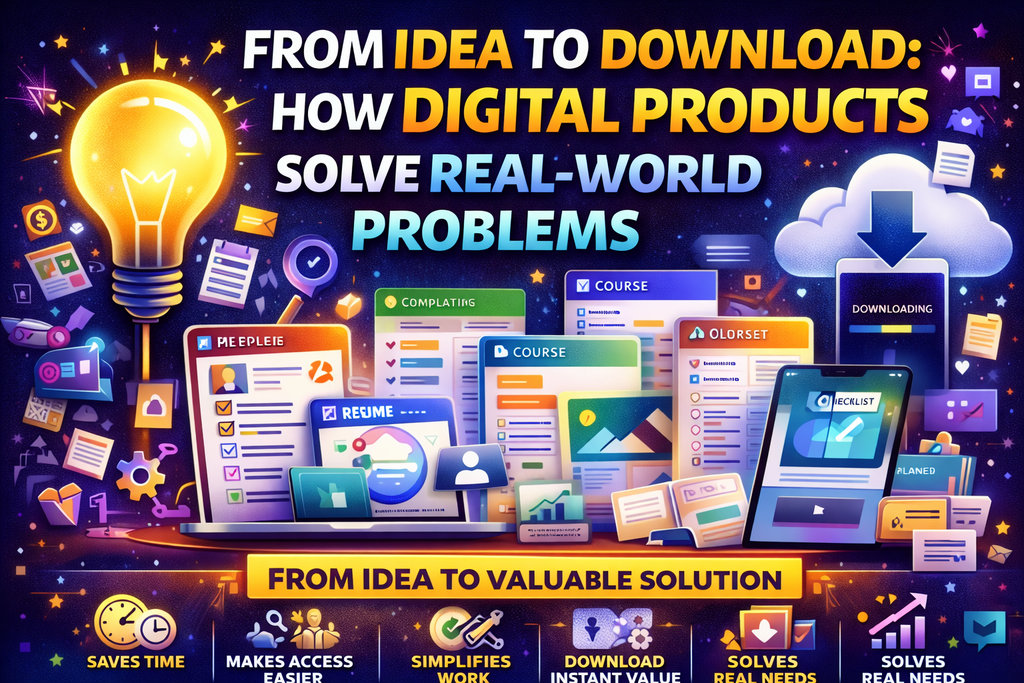
Digital products are often described as convenient, scalable, and easy to distribute. But their true value goes far beyond those business advantages. At their best, digital products solve real-world problems. They help people save time, learn skills, organize life, improve work, make decisions, reduce stress, and access resources that would otherwise be difficult, expensive, or slow to obtain.
This is what makes digital products so important in the modern world. They are not just files, downloads, or online tools. They are solutions packaged in a digital form.
A good digital product begins with a real need. It might come from a creator noticing a repeated struggle, a teacher wanting to simplify learning, a business trying to streamline operations, a designer solving a workflow issue, or an entrepreneur seeing a market gap. That idea is then turned into a product that someone can download, use, and benefit from almost immediately.
This journey from idea to download is one of the most powerful aspects of the digital economy. It allows people to transform knowledge, systems, creativity, and practical utility into tools that improve everyday life.
This article explores how digital products solve real-world problems, how they move from concept to usable solution, and why they continue to matter for creators, businesses, and buyers alike.
What Is a Digital Product?
A digital product is something created, delivered, and used digitally rather than physically. It can be downloaded, accessed through a platform, or used on a device such as a phone, tablet, or computer.
Common digital products include:
- Ebooks
- Templates
- Online courses
- Printables
- Worksheets
- UI kits
- Mockups
- Stock photos and videos
- Spreadsheets
- Dashboards
- Software tools
- Planners
- Checklists
- Notion templates
- Digital toolkits
What connects all of these is not only that they are digital. It is that they are designed to provide value in a practical, usable form.
Why Real-World Problem Solving Matters
Not every digital product succeeds just because it exists. The products that matter most are the ones that address real pain points.
People do not usually buy digital products because they want more files. They buy them because they want outcomes.
They want to:
- Save time
- Get organized
- Learn faster
- Work better
- Present themselves more professionally
- Reduce confusion
- Improve results
- Start something sooner
- Solve a repeated difficulty
This is why real-world usefulness is the foundation of strong digital products. The product becomes valuable because it solves something meaningful.
From Idea to Download: The Core Journey
Behind most successful digital products is a simple progression:
- A real problem is identified
- A useful solution is designed
- That solution is packaged digitally
- The user downloads or accesses it
- The problem becomes easier to handle
That journey sounds simple, but it is powerful because it removes friction between problem and solution.
A person may have a challenge today and a usable solution within minutes.
That speed and accessibility are part of what makes digital products so effective.
1. Digital Products Begin With Real Needs
The most useful digital products usually come from observation. Someone notices that people struggle with something repeatedly.
For example:
- Job seekers struggle to create polished resumes
- Students need clearer revision tools
- Businesses need faster content creation systems
- Freelancers need better client onboarding
- Teams need organized project tracking
- Creators want scalable income assets
- Teachers need structured classroom resources
A creator or entrepreneur sees one of these needs and asks: how can this problem be made easier?
That question is where many digital products begin.
2. They Package Solutions Into Practical Formats
Once a problem is clear, the next step is turning the solution into a usable format. This is where digital products become powerful.
A problem can be solved in different ways depending on the context.
For example:
- A knowledge problem may become an ebook or course
- An organization problem may become a planner or dashboard
- A workflow problem may become a template or toolkit
- A presentation problem may become a mockup or UI kit
- A learning problem may become worksheets or revision sheets
- A tracking problem may become a spreadsheet or database
This packaging step matters because it translates an idea into a tool people can actually use.
3. Digital Delivery Makes Solutions Fast and Accessible
One of the biggest strengths of digital products is speed. A user does not need to wait for shipping, inventory handling, or physical availability.
They can often:
- Buy instantly
- Download immediately
- Access from anywhere
- Start using the product right away
This is especially powerful when the problem is urgent.
For example:
- A small business needs a website template quickly
- A student needs practice material before an exam
- A job seeker needs a resume format today
- A creator needs social media templates for this week’s content
- A startup needs a pitch deck template for an upcoming meeting
The faster the product can be used, the more effectively it can solve the problem in real time.
4. Digital Products Save Time
Time is one of the most common real-world problems people want to solve. Many digital products exist because starting from scratch takes too long.
Templates, toolkits, planners, spreadsheets, mockups, and checklists all help save time by providing ready-made structure.
Instead of building from nothing, users can begin with:
- A proven format
- A usable system
- A clear layout
- A professional starting point
This is valuable because many problems are not about lack of effort. They are about lack of time, clarity, or efficient systems.
A well-designed digital product helps reduce those burdens.
5. They Simplify Complexity
Many real-world problems feel difficult not because they are impossible, but because they are overwhelming.
Digital products often solve this by simplifying complexity.
For example:
- A financial tracker simplifies money management
- A course simplifies learning a new skill
- A worksheet simplifies difficult subject revision
- A business toolkit simplifies startup execution
- A planner simplifies daily organization
- A UI kit simplifies product design
This simplification is powerful because it makes progress more approachable. People are more likely to act when the problem feels manageable.
6. They Improve Access to Knowledge and Tools
In the past, useful systems, education, and professional resources were often harder to access. They might depend on geography, budget, institutions, or specialized services.
Digital products help remove many of these barriers.
A person can now access:
- Learning resources from anywhere
- Business tools without large teams
- Planning systems without custom setup
- Design assets without building every element manually
- Career resources without expensive coaching
- Specialized knowledge without formal enrollment
This broader access is one reason digital products solve real-world problems so effectively. They make solutions more available to more people.
7. They Help People Act Faster
A lot of progress is delayed because people stay stuck at the setup stage. They know what they want to do, but they do not know how to begin.
Digital products help shorten this gap.
For example:
- A business plan template helps a founder begin planning
- A workout tracker helps someone begin consistency
- A study planner helps a student begin preparation
- A content calendar helps a creator begin organizing posts
- A resume template helps a candidate begin applying for jobs
This starting power matters. A product that helps people take the first step often solves a very real problem: inertia.
8. They Support Better Decisions
Many people struggle because they lack visibility into their situation. Numbers are unclear, priorities are scattered, or important information is hard to compare.
Digital products help support better decisions by organizing information more clearly.
Examples include:
- Budget sheets that show spending patterns
- KPI dashboards that show business performance
- Goal trackers that show progress gaps
- Comparison templates that help evaluate choices
- Business planners that clarify priorities
When information becomes more visible, better decisions become more possible.
That makes digital products useful not only for action, but also for judgment.
9. They Can Solve Problems at Scale
One of the most unique strengths of digital products is that they can solve the same kind of problem for many people repeatedly.
A teacher can create one worksheet pack that helps thousands of students.
A designer can create one UI kit that helps many app builders.
A creator can build one course that teaches many learners.
A business owner can sell one operational template to many startups.
This ability to solve similar problems for many users is why digital products are such powerful business models as well as practical tools.
10. They Help People Work More Professionally
Some real-world problems are about quality of presentation. A person may have the right skills or offer, but struggle to present them clearly.
Digital products help with this through tools such as:
- Resume templates
- Pitch decks
- Proposal templates
- Website templates
- Mockups
- Brand kits
- Presentation templates
These products help people appear more organized, polished, and professional. This can directly influence hiring, sales, trust, and customer perception.
11. They Create Repeatable Systems for Ongoing Problems
Some problems are not one-time issues. They happen repeatedly.
Examples include:
- Weekly content planning
- Monthly budgeting
- Client onboarding
- Team coordination
- Study revision
- Habit tracking
- Sales reporting
Digital products are effective here because they often create repeatable systems rather than one-time fixes.
A content calendar is not just a file. It is a system for ongoing organization.
A budget planner is not just a sheet. It is a system for recurring financial control.
This repeatable value makes digital products especially practical.
12. They Support Personal, Educational, and Business Growth
Digital products solve problems across many areas of life.
In personal life
They help with planning, goal tracking, budgeting, self-improvement, and organization.
In education
They support learning, revision, teaching, practice, and skill development.
In work
They help with productivity, communication, project management, and presentation.
In business
They support marketing, operations, planning, branding, sales, and customer delivery.
This broad usefulness shows that digital products are not limited to one niche. They solve real-world problems across many types of human activity.
Examples of Real-World Problems Solved by Digital Products
To understand their value more clearly, it helps to look at direct examples.
Problem: “I don’t know how to create a professional resume.”
Digital solution: A resume template and job search toolkit.
Problem: “I waste too much time designing the same social posts.”
Digital solution: A social media template pack.
Problem: “I need to learn this skill, but I can’t attend in-person classes.”
Digital solution: An online course or ebook.
Problem: “My finances feel messy and hard to track.”
Digital solution: A budgeting spreadsheet or expense tracker.
Problem: “I keep forgetting important tasks.”
Digital solution: A planner, task dashboard, or digital workspace template.
Problem: “I want to sell my product better online.”
Digital solution: Mockups, templates, product listing assets, or marketing kits.
In each case, the digital product addresses a specific friction point.
What Makes a Digital Product Truly Useful?
Not all digital products solve real-world problems equally well. The strongest ones usually have a few important qualities.
Clear problem-solution fit
The product should clearly address a meaningful need.
Ease of use
The user should understand how to apply it quickly.
Real practicality
The product should help the user take action or improve results.
Good structure
Information, layout, or workflow should be organized logically.
Accessible delivery
The product should be easy to obtain and use.
Relevant quality
The design, content, and usefulness should match the user’s expectations.
A good digital product makes life easier. A weak one adds clutter.
Why Buyers Keep Choosing Digital Solutions
People choose digital products because they fit the speed and flexibility of modern life.
They offer:
- Instant access
- Lower barriers to use
- Reusability
- Flexibility across devices
- Fast implementation
- Often lower cost than physical or service-based alternatives
In many cases, the digital solution is not only faster. It is also more practical for the way people now work, learn, and live.
Challenges to Keep in Mind
Digital products are powerful, but they are not automatically effective. Some are too generic, too complicated, or not truly tied to a real user need.
Common problems include:
- Creating products without validating demand
- Overcomplicating the solution
- Making the product look good but work poorly
- Solving a problem that is too vague
- Ignoring real user experience
The best digital products stay grounded in practical use.
Why Digital Products Will Keep Growing in Importance
As more of life moves online, people will continue needing fast, usable, digital solutions to everyday problems.
Digital products are likely to keep growing because they help people:
- Save time
- Learn independently
- Stay organized
- improve work quality
- build businesses
- access resources from anywhere
- reduce friction in daily tasks
That is why they are becoming more central not just in the economy, but in everyday problem-solving.
Final Thoughts
Digital products matter because they turn ideas into usable solutions. They begin with real needs, become structured tools, and reach users in a form that can be accessed and applied quickly.
From idea to download, a digital product can solve practical problems related to work, learning, planning, business, productivity, and everyday life. That is what makes them so powerful.
They are not just digital files. They are ways of making life easier, work faster, learning clearer, and progress more possible.
In the end, the most successful digital products are the ones that do something simple but meaningful: they help people solve real problems better than before.
Comments (0)